When you buy a travel eSIM, you usually choose between a plan with a set number of gigabytes and an “unlimited” plan that costs more. If you mostly use maps, messaging and browsing, a fixed plan with some spare data is often the cheaper choice. Unlimited is worth it when you stream, share a hotspot or work online, as long as you know how much high-speed data the plan gives you each day. This guide compares Unlimited vs Fixed data plan options: how each one works, where “unlimited” plans are limited, how to estimate your data and what a 15-day trip costs to help you choose the right plan.
In this article
What is the difference between an unlimited and a fixed data plan?
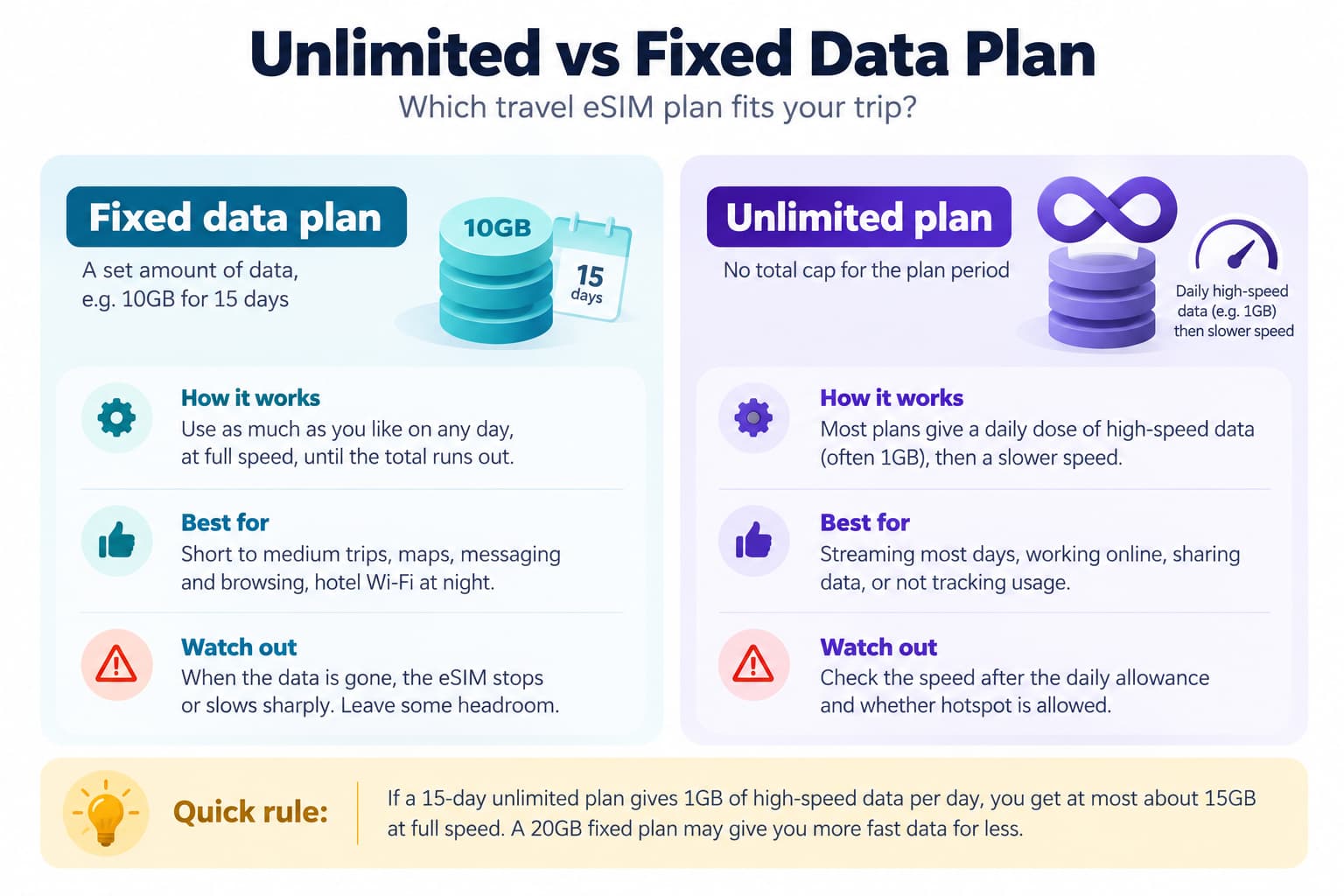
A fixed data plan gives you a set amount of data for the entire validity period, while an unlimited plan lets you continue using data but may reduce your speed after a daily high-speed allowance.
Here is how they compare:
Fixed data plan (Total): You get a total allowance, such as 10GB or 20GB, to use throughout your trip. Your daily usage can vary without a separate daily limit.
Unlimited data plan: You can continue using data, but many plans reduce your speed after a daily high-speed allowance. Most Gigago Unlimited plans provide 1GB of high-speed data per day before slowing down until the allowance resets.
How do daily data plans differ from fixed and unlimited plans?
A daily data plan gives you a set amount of data each day, which resets according to the plan’s schedule. It suits travelers whose data usage is fairly consistent and who can stay within the daily allowance.
Unlike a fixed (Total) plan, a daily plan generally does not let you carry unused data forward to a busier day. If you exceed the daily limit, your connection may stop or slow down, depending on the plan.
For example, Gigago’s Japan eSIM Daily plans stop providing data when you reach the daily limit. The allowance resets at 23:59 GMT+8, not at midnight in Japan. If you expect to use much more data on certain days, check the daily allowance and reset time before choosing this plan type.
What happens when your data runs out?
When you reach your data limit, your connection may stop or slow down, depending on the plan’s rules.Some plans also support top-ups, but this option is not available for every eSIM.
Plan type
What happens at the limit
Gigago example
Fixed (Total)
The connection may stop or the speed may drop sharply, depending on the plan
China Total plans drop to 128 kbps
Daily
The connection may stop until the next day or reset
Japan Daily and Vietnam Viettel daily plans
Unlimited with a daily allowance
Speeds are reduced for the rest of the daily period
Europe and Singapore drop to 5 Mbps after 1GB of high-speed data
Most Gigago plans do not support top-ups, so if you run out of usable data, you may need to purchase and install another eSIM. Some Vietnam and Thailand plans offer top-ups, but they are exceptions.
If you need to install a new eSIM after running out of data, connect to Wi-Fi first. You will need an internet connection to complete the setup.
Is an unlimited travel eSIM really unlimited?
An unlimited travel eSIM may offer unlimited data usage without providing unlimited high-speed data. Many plans reduce your speed after you use a daily high-speed allowance, while others maintain a fixed speed or have no daily high-speed cutoff.
No daily 1GB high-speed cutoff, but other speed conditions may apply
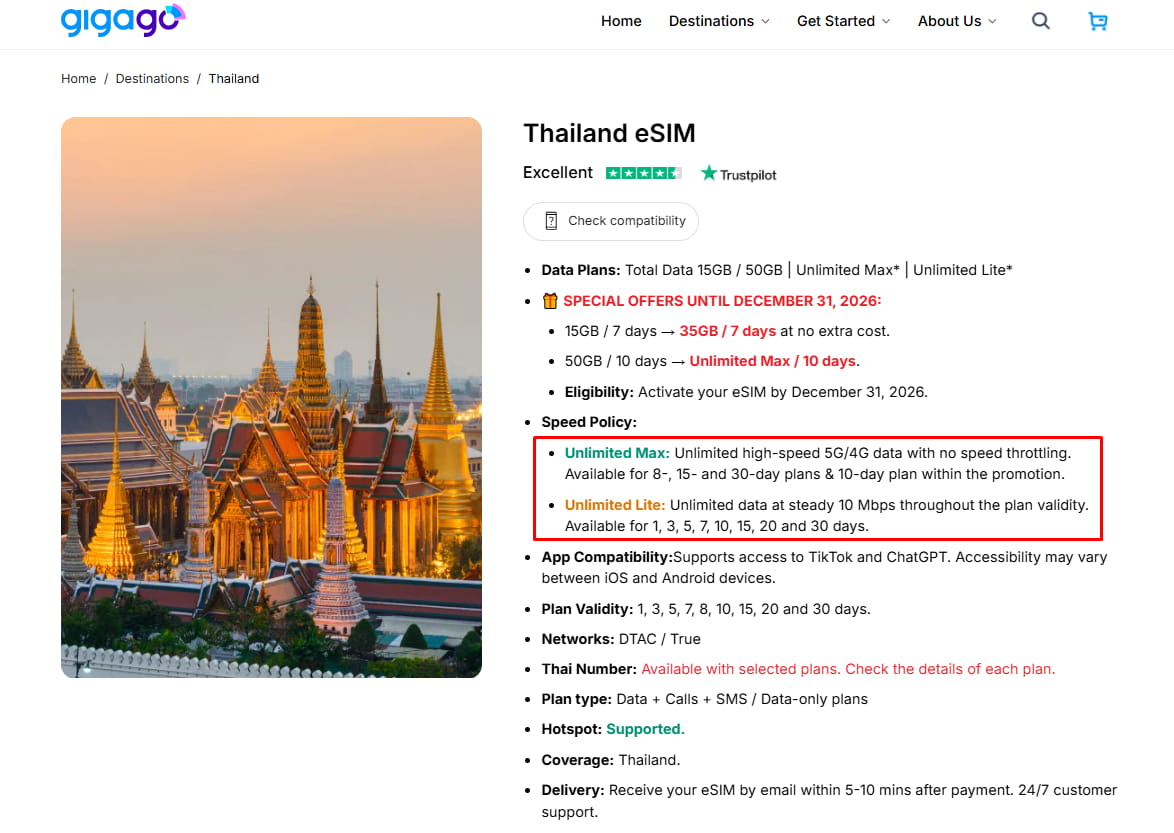
Thailand eSIM‘s Unlimited Max offers high-speed data, while Unlimited Lite runs at a steady 10 Mbps. Vietnam Unlimited has no fair usage limit according to current product information.
Check the speed conditions before buying, not just the word “unlimited.” The daily high-speed allowance, reduced speed and any fair usage policy can make a significant difference to your experience.
Policy of different types of unlimited plans of Gigago’s Thailand eSIM
Is the slower speed still usable?
A reduced speed of 5–10 Mbps is generally enough for everyday tasks on one device, but 128 kbps is much more restrictive. Your experience will also depend on signal strength, network congestion and the apps you use.
Activity
Recommended speed
Source
Netflix in Full HD (1080p)
5 Mbps
Netflix Help Center
YouTube in 720p
2.5 Mbps
YouTube Help
Zoom video call in 720p
1.2 Mbps
Zoom Support
Zoom audio-only call
60–80 kbps
Zoom Support
Going by these figures, at 5 Mbps, you can generally use maps, messaging and video calls, or stream video on one device.
At 10 Mbps, you have more room for additional activity or another device, although hotspot performance varies.
At 128 kbps, basic text messages may still work, but browsing image-heavy pages and streaming video can become frustratingly slow.
Before choosing an unlimited plan, check whether its reduced speed will support your everyday travel needs. A plan can provide unlimited data but still feel restrictive if its post-allowance speed is too slow for your activities.
How much data will you actually use?
Your recent mobile data usage is the best starting point for estimating how much data you need on a trip. Use these steps to calculate a baseline:
Divide that amount by 30 to estimate your average daily use.
Multiply the daily average by the number of travel days.
Adjust the result for your travel habits. Add more if you will rely heavily on navigation, translation, video or mobile data for work. You may need less if you have reliable Wi-Fi at your accommodation.
Your travel habits can make a significant difference. For example, one traveler may use only a few gigabytes over a 10-day trip by mainly using maps and messaging, while someone who streams video, uploads media or works online may use considerably more.
Treat your calculation as a baseline, not a strict limit. Leave some extra data for unexpected needs, especially if you plan to rely on mobile internet throughout the day.
Unlimited vs. Fixed Data plans – Which is cheaper for your trip?
A fixed data plan may cost less while providing more high-speed data, whereas an unlimited plan may offer better value if you need more data than a fixed allowance provides.The best option depends on both the price and the speed conditions after any daily limit.
The following comparison uses the Gigago prices and plan conditions provided for October 2026.
Gigago’s Europe eSIM plan
Price for 15 days
Data conditions
Unlimited
$51.50
1GB high-speed data per day, then 5 Mbps
20GB Total
$31.00
20GB total allowance
10GB Total
$17.50
10GB total allowance
1GB Daily
$23.50
1GB per day
For this example, the 20GB Total plan costs $20.50 less than the Unlimited plan. It may be a better choice if 20GB is enough for your trip. However, the Unlimited plan lets you continue using data at 5 Mbps after the daily high-speed allowance, while a fixed plan’s behavior after its total allowance runs out depends on its terms.
However, the comparison changes when an unlimited plan has no daily high-speed cutoff. At the time of writing, 15 days of Thailand Unlimited Lite cost $24.90, while 15 days of Vietnam Unlimited cost $20.90. Both plans offered their stated unlimited-data conditions without the 1GB-per-day cutoff described above.
Note: Prices and product conditions can change. Check the relevant Gigago product page for current prices and plan details before purchasing.
Fixed vs Unlimited Data Plan: Which Should You Choose?
Choose a fixed plan if your estimated data usage fits within its allowance; choose an unlimited plan if you need to keep using data without worrying about a total data cap. If you choose unlimited, check the reduced speed and daily high-speed allowance first.
Remember to check the hotspot terms before you buy, because not every unlimited plan allows it. If you plan to connect a laptop, read how much data a hotspot uses first, as laptop updates and cloud syncing can use much more data than a phone.
Use this quick comparison to narrow down your options.
Your trip
Plan type to consider
Short city break, mostly maps and messaging
Fixed plan with some headroom
Two weeks, moderate social media, hotel Wi-Fi
Fixed plan in the 10–20GB range
Steady daily use with no heavy days
Daily plan
Streaming most days or working online
Unlimited plan, ideally with no daily allowance
Sharing data with family or a laptop
Unlimited or a large fixed plan, with hotspot allowed
Note: On plans with a daily high-speed data limit, automatic photo backups and app updates can use up your allowance quickly. Turn them off on mobile data or enable Low Data Mode. See Gigago’s guide to saving data on iPhone for setup instructions.
Check the high-speed allowance, reduced speed, reset time, hotspot rules, data-limit behaviour, validity and coverage before paying.
High-speed allowance and reset time: Check how much high-speed data you receive and when the allowance resets. The plan’s time zone may differ from your destination’s local time.
Speed after the allowance: A reduced speed of 5 Mbps is very different from 128 kbps.
Hotspot support: Confirm that tethering is permitted if you need to connect a laptop or share data.
What happens at the limit: Check whether the connection stops, slows down or supports top-ups.
Validity and coverage: Confirm when the plan starts counting days and that every country on your itinerary is covered.
Conclusion
The best choice between an unlimited and fixed data plan depends on how you use mobile data while travelling. A fixed plan is usually more cost-effective for maps, messaging, browsing and moderate social media use, while an unlimited plan suits heavier users who stream, work online or need a more flexible data allowance.
Many travelers worry when their eSIM only shows 4G or LTE, or wonder whether they should pay attention to plans labeled 5G. For maps, messaging, ride-hailing and most video calls, 4G/LTE is usually enough, and 5G mostly helps with heavy data use when your phone, plan and local network all support it. This guide compares […]
When a flight is delayed or cancelled, a reliable internet connection helps you check airline updates, find rebooking options and notify your hotel or airport transfer about changes to your arrival time. Airport Wi-Fi may be slow or unavailable when you need it, so having mobile data ready before your trip gives you another way […]
eSIM validity is the period during which your data plan remains usable. Depending on the plan, the countdown starts when you install the eSIM by scanning its QR code or when it first connects to a supported network at your destination. Your plan expires when its validity period ends or if you use up the […]
Most travelers want mobile data the moment they land, without uploading a passport or queuing to register a SIM at the airport. The good news is that many data-only travel eSIMs can be purchased online without ID verification. However, some plans, especially those with a local phone number, may require identity verification before you can […]
A travel eSIM can stop working on your iPhone because the line was turned off, your data is running through another SIM, or the eSIM was deleted. If the eSIM still appears in Settings > Cellular, you can usually get back online by turning the line on, selecting it for cellular data and checking Data […]
Buying too little data for 15 days in Japan means running out mid-trip, while buying too much wastes money. A typical traveler who uses maps, messaging and social media daily can expect to use around 1GB a day, so a 20GB plan covers roughly 15GB of use with a buffer. Light users can usually manage […]