eSIM validity is the period during which your data plan remains usable. Depending on the plan, the countdown starts when you install the eSIM by scanning its QR code or when it first connects to a supported network at your destination. Your plan expires when its validity period ends or if you use up the included data first.
This guide explains when eSIM validity starts, how days are counted, how long you have to install your eSIM, and what happens when your data or validity runs out. You’ll also learn how to choose a plan that covers your entire trip.
In this article
What does eSIM validity mean?
eSIM validity is the number of days a data plan stays usable, such as 7, 15 or 30 days. It is separate from the plan’s data allowance.
For a fixed-total-data plan, you have two limits: the validity period and the total amount of data included. Depending on the plan, your connection may stop or slow down when you use all your data, even if some validity days remain. If the validity period ends first, any unused data is generally lost.
For example, suppose a plan includes 10GB of data for 7 days. If you use all 10GB by day four and the plan does not offer additional data, your connection may stop before the seven days are over. If you still have 3GB remaining when day seven ends, you generally cannot use that data after the plan expires.
When does eSIM validity start?
The start date depends on the plan. Most travel eSIMs follow one of two rules:
Validity starts at installation: The countdown begins when you scan the QR code and install the eSIM.
Validity starts on first connection: You can install the eSIM earlier, but the countdown begins when it first connects to a supported network under the plan’s activation rules.
Check the product page before installation because the two rules can apply to different plans in the same destination.
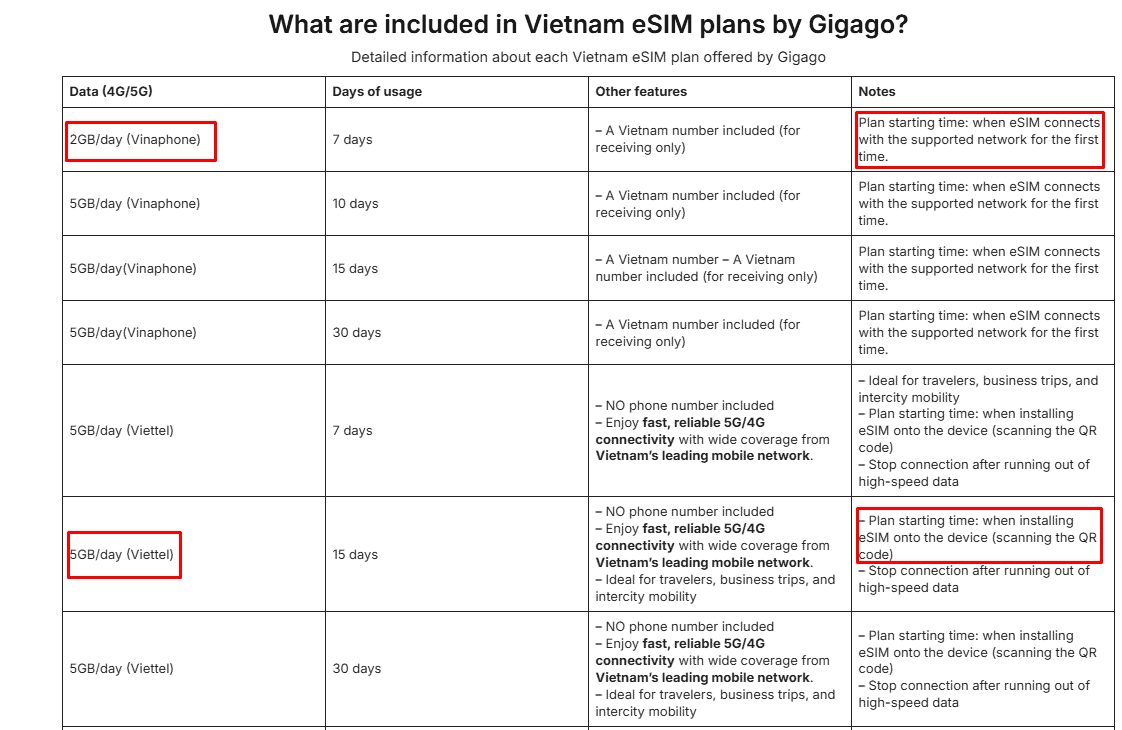
For example, on Gigago’s Vietnam eSIM page, the the Viettel plan starts counting validity at installation, while the Vinaphone plan starts when the eSIM first connects to its supported network.
The difference of validity start date between plans of Gigago’s Vietnam eSIM
Plans that start when you install the eSIM
For these plans, the day you scan the QR code counts as day one, even if you are still at home. Installing too early can use up part of your validity before you arrive at your destination.
Gigago recommends installing these eSIMs close to your departure, such as the day before your flight or on your travel day, while you still have access to Wi-Fi. Always follow the installation instructions for your specific plan.
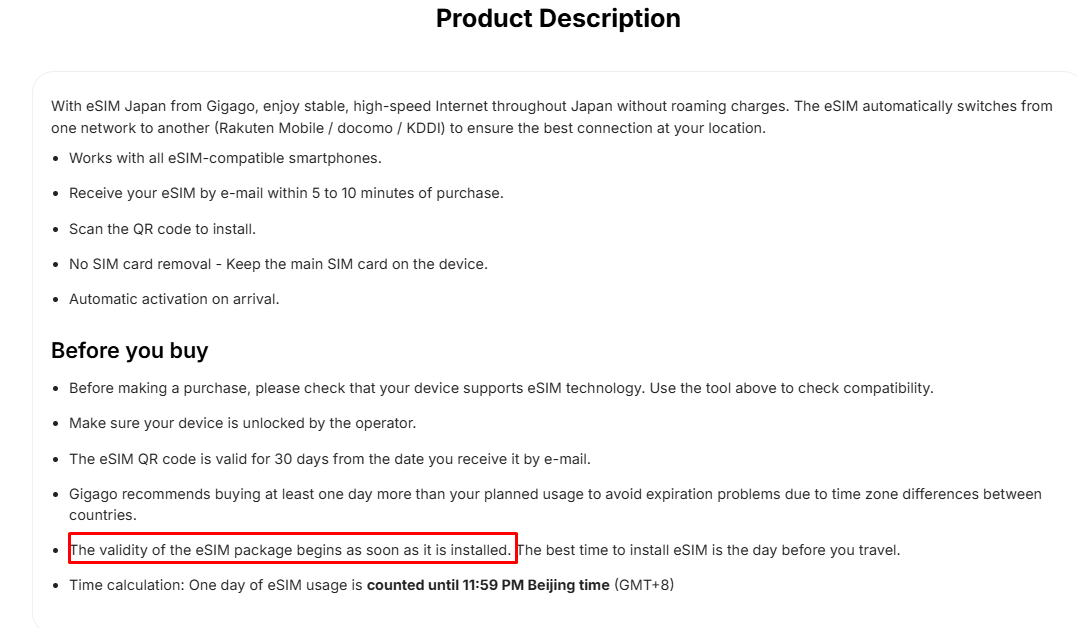
Gigago’s Japan and China eSIM plans are examples of plans that start at installation. If you scan the QR code 3 days before departure, those days count toward your validity even if you have not yet used mobile data abroad.
So, before scanning the QR code, check whether your plan’s validity starts at installation. If it does, wait until the recommended time to install it so you do not lose days unnecessarily.
Note about validity start date of Gigago’s eSIM Japan
Plans that start on first connection at your destination
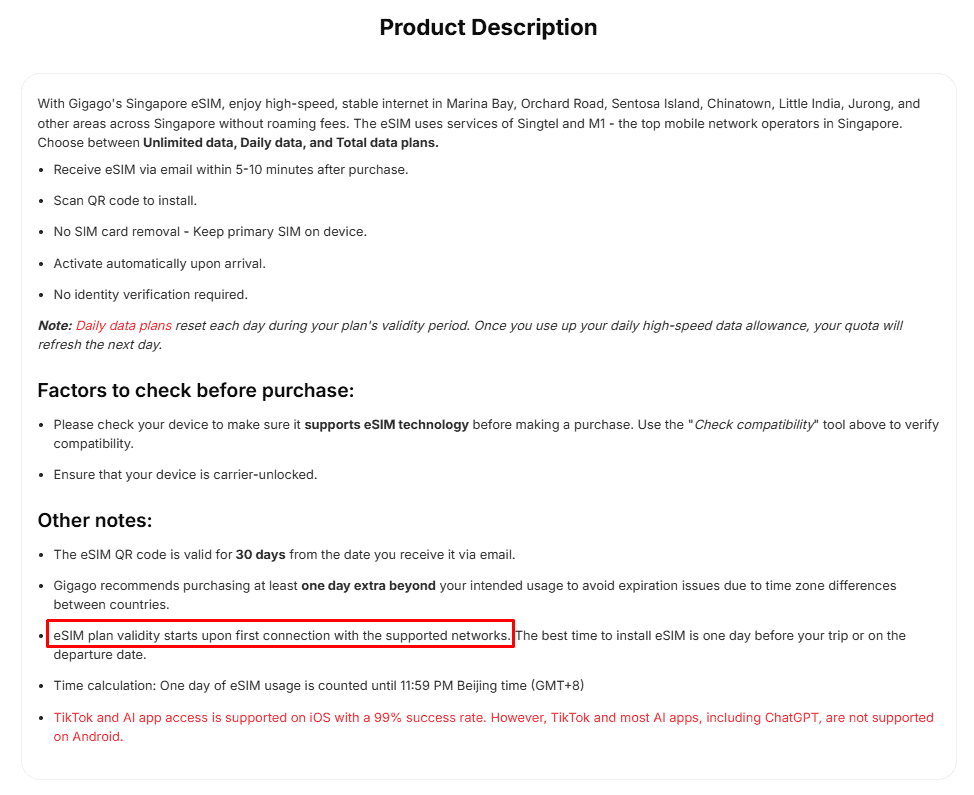
With these plans, you can generally install the eSIM before your trip without using up validity days immediately. The countdown begins when the eSIM connects to a supported network, according to the plan’s activation rules.
Besides, some plans also require a separate activation step. For example, Gigago’s Local/MobiFone plans for Vietnam ask you to press “Activate” through the link sent with your QR code. Follow the activation guide in your email to complete the required steps.
For these plans, follow the product page and setup instructions to understand exactly when validity begins. The installation date and validity start date may be different, so check the activation rules before setting up your eSIM.
Note about validity start date of Gigago’s eSIM Singapore
How are days counted on an eSIM plan?
An eSIM’s validity may be counted by calendar day rather than by 24-hour periods.
Many Gigago plans end each validity day at 11:59 PM Beijing time (GMT+8), while some plans, including certain Vietnam plans, use local time.
When a plan uses a fixed daily cut-off, a day is not 24 hours from the moment you activate, so your first day can be much shorter.
Gigago’s Vietnam eSIM page provides a simple example. If a plan uses a cut-off of 11:59 PM Vietnam time and you activate it at 11 PM, your first validity day ends just one hour later.
This is why it is important to check the time calculation on your product page or or ask the provider if your plan doesn’t mention it. The time zone and daily cut-off can affect how much usable time you get from the first and last days of your plan.
How long do you have to install an eSIM after buying it?
With Gigago, you must install your eSIM by scanning the QR code within 30 days of receiving the email containing it. After that, the QR code expires and can no longer be used to install the eSIM.
Note that this 30-day installation window is separate from your plan’s validity period, which begins at installation or first connection.
Refunds follow a separate policy. Gigago’s refund policy offers a full refund for an eSIM that hasn’t been installed, as long as you ask within 30 days of the purchase date.
Pro-tips:
Don’t scan the QR code just to test it before your trip. On a plan that starts at installation, that test would also start your days.
Don’t buy months ahead just to lock in a price. Buy within 30 days of the date you plan to install.
What happens when your data or validity runs out?
What happens when you use all your data depends on the type of plan. When the validity period ends, the plan expires and any unused data is generally lost.
Plan type
If the data runs out first
When the days run out
Total data (one allowance for the whole plan)
Usually stops connecting. Some plans slow down instead, such as Gigago’s China fixed plans
Plan stops
Daily data (a set amount each day)
You may need to wait for the next daily allowance to become available.
Plan stops
Unlimited
Speeds may decrease after the daily high-speed allowance is used.
Plan stops
For example, on Gigago’s Vietnam daily plans, the connection stops when the day’s data allowance is used up. The new allowance arrives around midnight Vietnam time (GMT+7). Exact speeds and limits vary by plan, so check the product page for yours.
With a total-data plan, you might try to save data for the final days of your trip. However, if the validity period ends first, any remaining allowance is generally lost. Choose a plan that covers both your expected data usage and the full period during which you need a connection.
For more information, read our guide to unlimited eSIMs explains how speed limits work.
How do you choose the right validity for your trip?
To choose the right validity, count the calendar days during which you need mobile data, including your arrival and departure days. Then consider adding one extra day, as Gigago recommends, to allow for the plan’s daily cut-off and time zone differences.
Follow these steps:
Find the start day. For a plan that starts at installation, it’s the day you install. For a plan that starts on connection, it’s the day you reach the first country the plan covers.
Count every calendar day from that start day to the day you fly home.
For example, Gigago’s Japan plans start at installation. Say you install the day before your flight, land the same day you fly and spend six nights in Japan. From install day to departure day is eight days, or nine with the extra day. Gigago’s Japan plans include 7-day and 10-day options, so the 10-day plan covers you.
A common mistake is choosing validity based only on hotel nights. Six nights in a destination can mean seven calendar days in the country, and you may still need maps, messaging and transport apps on your departure day.
Once you know how many days you need, compare the available validity options for your destination on Gigago’s Buy eSIM page.
In most cases, you can’t. Turning off the eSIM line, disabling mobile data or switching off your phone does not stop the countdown.
Currently, most Gigago eSIM plans do not support top-ups. If you need more data or more days, you may need to purchase a new plan on the Gigago website or app. There is only one exception: Some Vietnam eSIM products may allow balance top-ups through a separate process using a Vietnamese bank card. Check your product page for the options available to your plan.
Turning off the line only stops your phone from using the plan, while the days keep counting. Our guide on pausing a travel eSIM explains this in more detail.
If you’re staying longer than your plan, buy another plan before the first one ends. The new plan comes with its own QR code, separate from your current eSIM. You need internet to install it, which can be Wi-Fi or the mobile data left on your current plan. If the new plan starts at installation, install it close to the last day of the first plan so the two don’t overlap.
Finally, don’t delete an eSIM you’re still using in the hope of restarting its validity. If you buy eSIM from Gigago and something isn’t working, contact Gigago support before you delete anything.
Frequently asked questions
Do I need Wi-Fi to install a travel eSIM?
In most cases, yes, because your phone needs an internet connection to download the eSIM. That’s why Gigago suggests installing before you leave home. If your plan starts at installation, do it the day before you fly or on your travel day.
Does a Gigago eSIM expire if I never install it?
The QR code stops working 30 days after you receive it by email, and you can no longer install the eSIM after that. For more on what happens to unused eSIMs, see our guide on whether a travel eSIM expires if not used.
Where can I find my plan’s validity rules?
Check the product page for the validity period, when validity starts and how days are counted. Note whether the countdown begins at installation or on first connection to a supported network, along with any daily cut-off time. If the instructions are unclear, ask Gigago support before scanning the QR code.
Does turning off my eSIM stop the validity countdown?
No. Once the validity period has started, turning off the eSIM line, disabling mobile data or switching off your phone does not pause the countdown.
Can I extend my Gigago eSIM validity without buying another plan?
Most Gigago eSIM plans do not support top-ups. If you need additional data or days, you may need to buy another plan. Some Vietnam eSIM products have a separate balance top-up process, so check the conditions for your specific product.
Should I buy a plan that matches the number of nights in my hotel?
Not necessarily. Count the calendar days during which you need mobile data, including your arrival and departure days. Also check the plan’s validity start rule and daily cut-off time, and consider adding one extra day as a buffer.
Most travelers want mobile data the moment they land, without uploading a passport or queuing to register a SIM at the airport. The good news is that many data-only travel eSIMs can be purchased online without ID verification. However, some plans, especially those with a local phone number, may require identity verification before you can […]
A travel eSIM can stop working on your iPhone because the line was turned off, your data is running through another SIM, or the eSIM was deleted. If the eSIM still appears in Settings > Cellular, you can usually get back online by turning the line on, selecting it for cellular data and checking Data […]
Buying too little data for 15 days in Japan means running out mid-trip, while buying too much wastes money. A typical traveler who uses maps, messaging and social media daily can expect to use around 1GB a day, so a 20GB plan covers roughly 15GB of use with a buffer. Light users can usually manage […]
Before traveling to mainland China, download and set up the apps you’ll need for payments, messaging, maps, transportation and translation. Many familiar services, including Google services, WhatsApp and Instagram, are blocked on standard mainland Chinese networks, so it’s important to prepare alternatives before you arrive. Start with Alipay or WeChat Pay for payments, WeChat for […]
A good navigation app needs to do more than find the fastest route when you’re traveling abroad. You may need offline directions, public transit information, reliable place details, or navigation in a country where some services are restricted. So, which is better for travel: Apple Maps or Google Maps? This guide compares Apple Maps and […]
One of the most common questions travelers have before using an eSIM is “Does time zone affect your travel eSIM’s validity period?” whether changing time zones will shorten their data plan. If you buy a 7-day eSIM, fly across multiple countries, or cross the International Date Line, it’s natural to wonder whether changing time zone […]