

|
This guide tells you everything for getting a Kenya SIM card. Having one gives affordable access when exploring amazing spots in Kenya.
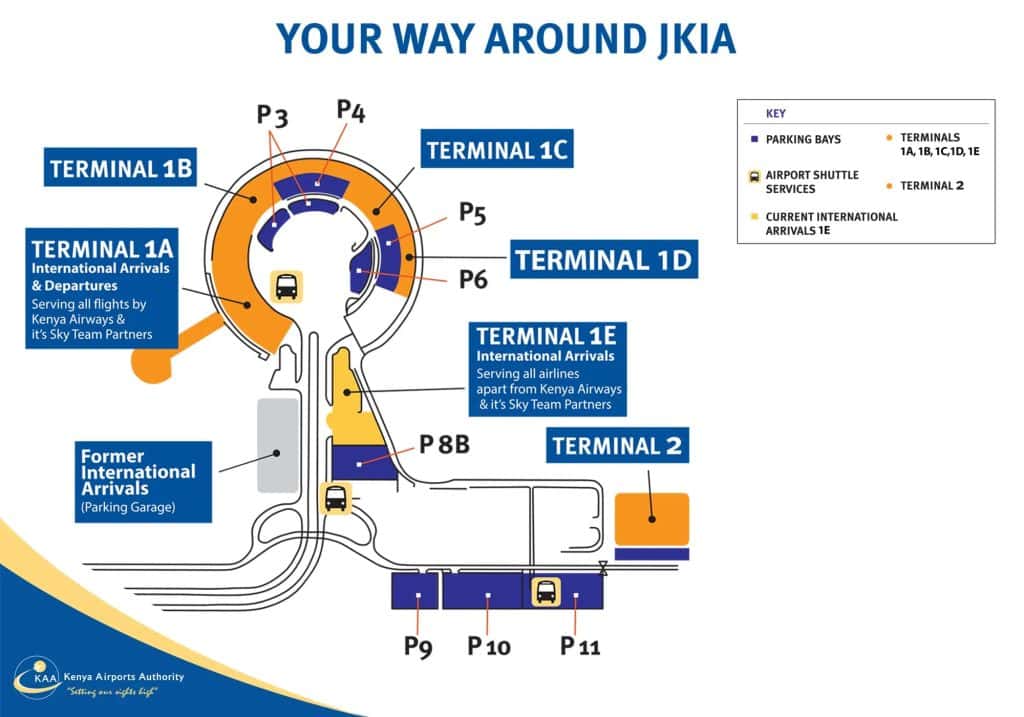
Buying a local SIM card as soon as you land at Nairobi’s Jomo Kenyatta International Airport (NBO) is the fastest way to get online in Kenya. Right after you clear customs in Terminal 1A, you will see counters for Kenya’s three main carriers: Safaricom, Airtel, and Telkom. This guide covers exact counter locations, tourist plan prices, registration rules, and convenient eSIM options so you can get connected without hassle.
In this article
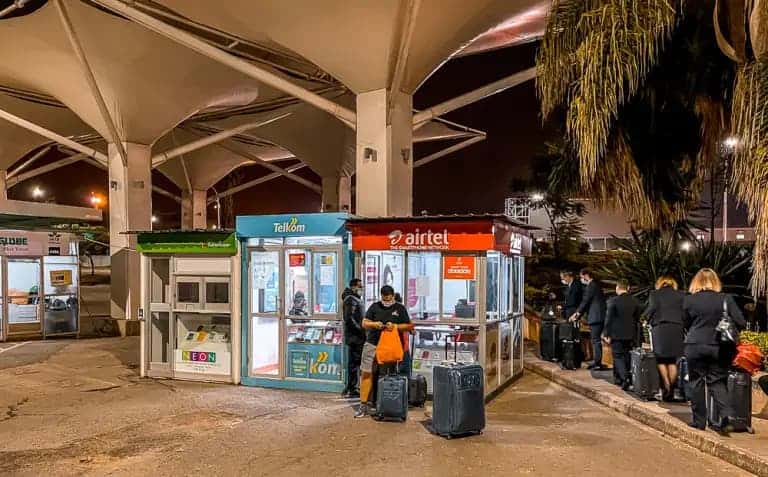
You can buy SIM cards at official kiosks of Safaricom, Telkom, and Airtel conveniently located side by side in Terminal 1A right after clearing customs.
Opening hours: Both Airtel and Telkom operate 24/7. Safaricom typically closes around 9:00 PM.
If your flight arrives late at night and you specifically want Safaricom, setting up an eSIM before you fly is your best bet.
Queue times at airport counters are the biggest factor travelers highlight. During peak flight arrival times, lines at the Safaricom desk can take up to an hour to navigate. If you land during a busy period and want to leave the airport quickly, checking the 24/7 Airtel counter or setting up an eSIM beforehand helps you avoid terminal bottlenecks entirely.
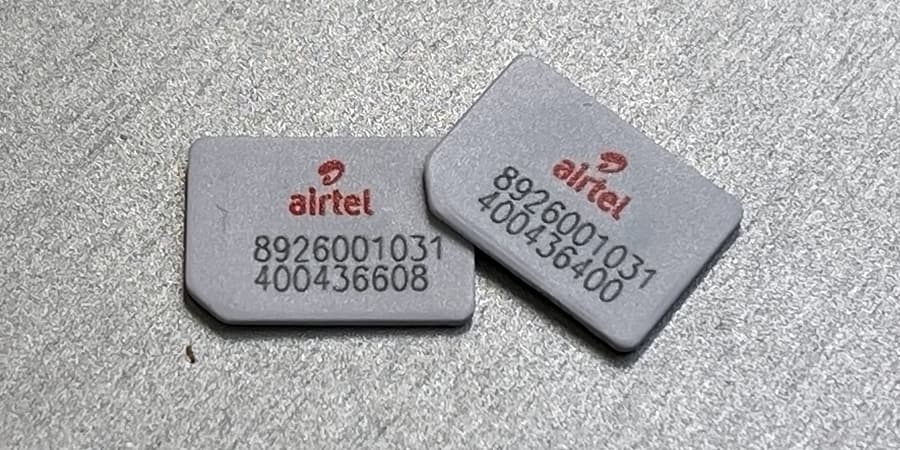
Yes, Kenyan law requires all subscribers to register prepaid SIM cards using a valid passport, but the process is quick and straightforward.
The counter clerk scans your passport and registers your SIM within about 10 minutes as part of your purchase. Under Kenya’s Communications Authority rules (Legal Notice No. 90), operators only collect standard passport verification—you do not need to provide fingerprints or biometric scans.
Pro Tip: While at the counter, ask the staff to activate M-Pesa on your line. M-Pesa is Kenya’s ubiquitous mobile payment service, used everywhere from taxi drivers to market stalls. Setting it up immediately saves you a trip to a retail shop later.
A physical SIM card at Nairobi Airport costs around 200 KES (~$1.50 USD), which includes 150 KES of starter airtime before you add a data bundle on top.
Prices for tourist data bundles vary depending on the carrier you choose. Let’s see noticeable plans of each network carrier below:
These are Safaricom’s own current tourist bundles, available during your first 90 days on the network.
| Data | Minutes | Price |
|---|---|---|
| 12GB | 400 local + 100 international | 2,000 KES |
| 22GB (data-focused) | n/a | 2,000 KES |
| 25GB | 1,000 local + 100 international | 3,000 KES |
| 39GB | 1,500 local + 100 international | 4,000 KES |
Airtel recently adjusted its data allowances while keeping plan prices the same:
| Plan Name | Data Allowance | Validity | Price (KES) |
| Smarta 1000 | 22 GB | 30 days | 1,000 KES (~$7.75 USD) |
| Smarta 1500 | 32 GB | 30 days | 1,500 KES (~$11.60 USD) |
Note: While Airtel’s recent data adjustment narrowed the value gap with Safaricom, Airtel remains a budget-friendly option for city stays
Telkom offers various prepaid packages at their airport counter, though exact tourist bundle inclusions change frequently. You should ask the clerk at their 24/7 counter for their latest offers upon arrival.
Setting up an eSIM online before departure is the easiest way to skip long airport lines, bypass late-night counter closures, and connect immediately upon landing.
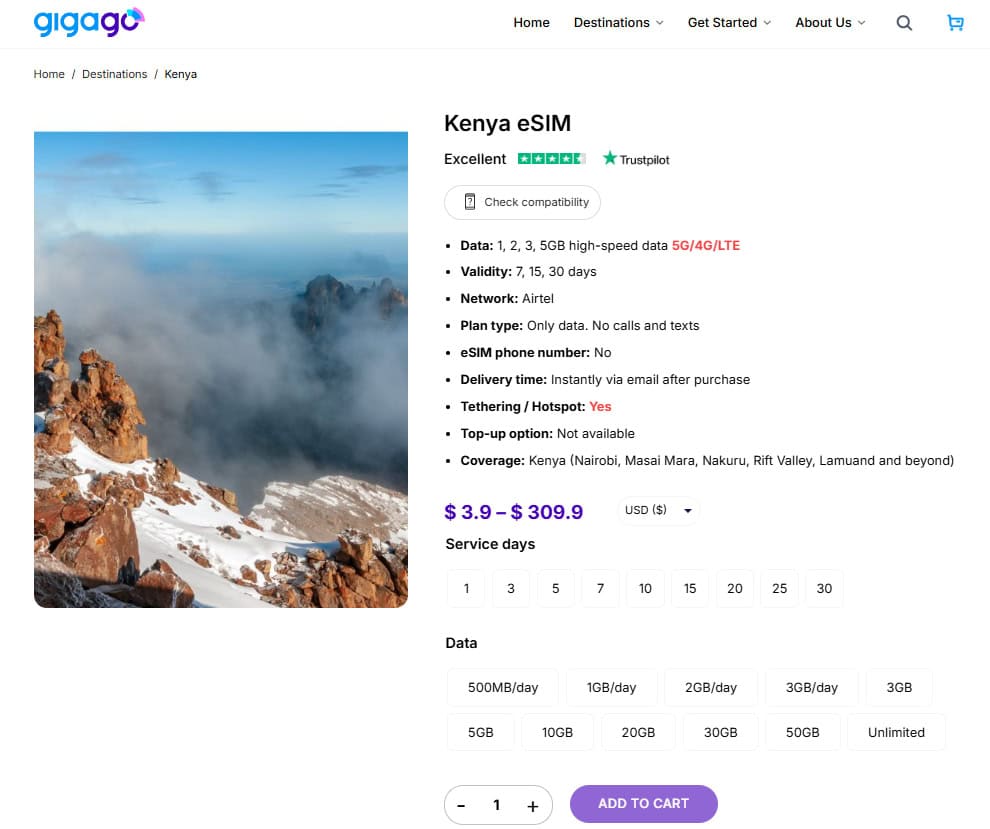
If you want a hassle-free setup, Gigago’s Kenya eSIM provides an effortless digital alternative. It connects directly to the reliable Airtel network. You can purchase your plan online, scan a QR code sent to your email, and activate it instantly on your device. You can skip counter waiting lines, passport scanning bureaucracy, and physical SIM card swaps.
The plans start at just $3.90 USD for light usage and up to $309.90 USD for heavy-data, extended stays.
Safaricom is the undisputed network leader in Kenya, delivering the fastest speeds and the most reliable coverage across rural areas, safari parks, and national reserves.
If your itinerary includes trips outside major cities like Nairobi or Mombasa, Safaricom is the safest default choice. According to recent nPerf network benchmarking for Kenya:
| Performance Metric | Safaricom | Airtel |
| Overall Network Score | 48,015 (Winner) | 30,156 |
| Average Download Speed | 30.55 Mbps | 13.20 Mbps |
| Average Upload Speed | 9.67 Mbps | 4.74 Mbps |
| Latency (Lower is better) | 49.62 ms | 83.06 ms |
| Successful Web Browsing | 40.76% | 34.19% |
| YouTube Streaming Quality | 67.17% | 60.68% |
Note: Telkom was excluded from independent comparative testing due to a lower market share footprint
Yes. Kenyan telecom regulations require every foreign traveler to register their SIM card using a physical passport.
Yes, but only from selected carriers. Airtel and Telkom operate 24-hour counters. Safaricom’s desk generally closes around 9:00 PM, so an eSIM bought before flying is recommended for late-night Safaricom connections.
No. The Communications Authority of Kenya has confirmed that SIM registration rules only require standard passport ID verification – no fingerprints or facial scans are collected.
This guide tells you everything for getting a Kenya SIM card. Having one gives affordable access when exploring amazing spots in Kenya.