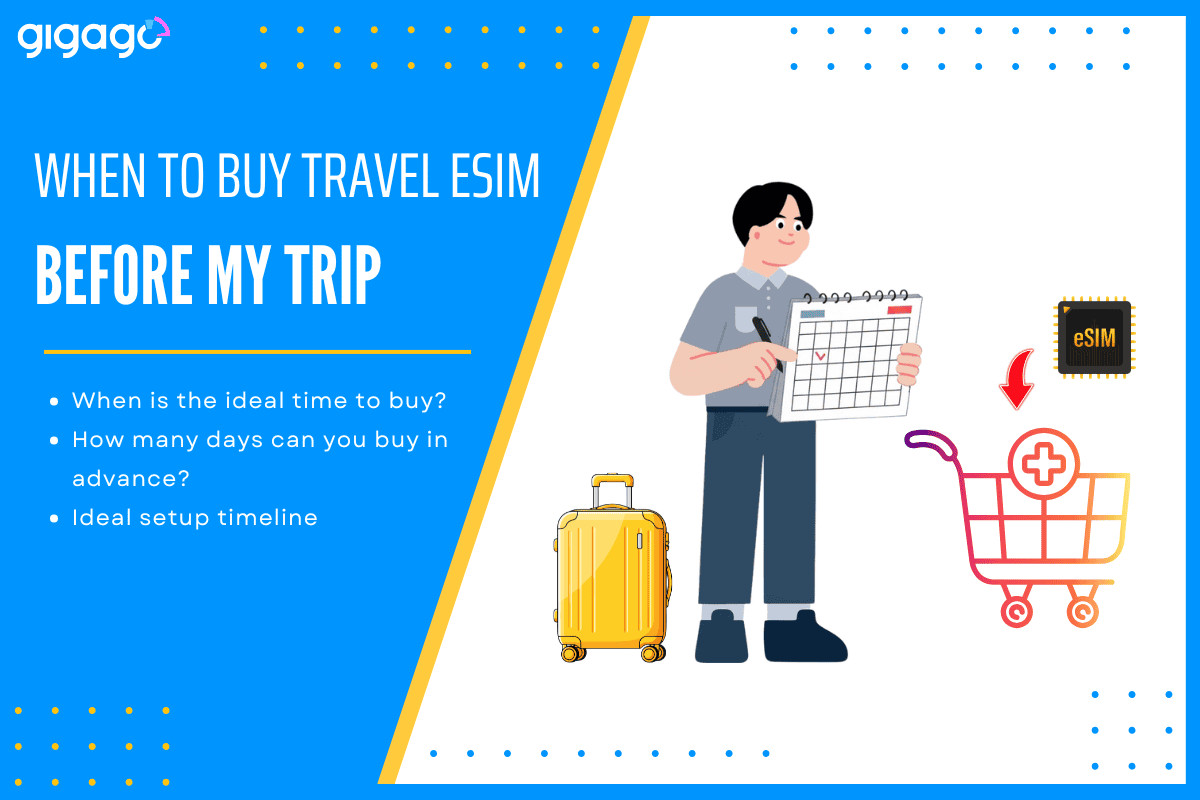
A travel eSIM is one of the easiest ways to get mobile data abroad – no physical SIM cards, no hunting for a kiosk, and no surprise roaming charges. But many travelers still ask the same question: when should I buy a travel eSIM before my trip?
The good news is you can usually purchase an eSIM ahead of time and set it up calmly at home. The key is understanding timing: buying, installing, and activating are not always the same thing. This guide explains the ideal time to buy, how many days in advance is best, and what to check so everything works smoothly when you land.
In this article
I. When is the ideal time to buy an eSIM?
For most travelers, the ideal time to buy a travel eSIM is a few days before departure. That gives you enough time to:
Choose the right plan for your destination (or multiple countries)
Confirm your phone supports eSIM and is unlocked
Install the eSIM without rushing
Fix any issues (wrong plan, device settings, QR code access) before you travel.
II. How many days can you buy an eSIM before your trip?
While 1–3 days is ideal, you can safely purchase your eSIM up to one week before your trip.
Here’s a simple guide based on real travel situations:
Buy 7–10 days before if:
You’re traveling internationally for the first time with an eSIM
You’re visiting multiple countries
You need data immediately upon landing (maps, ride-hailing, hotel check-in)
You want time to compare plan sizes/prices and avoid choosing the wrong one
Buy 3–7 days before if (most people):
Your travel dates and destination are confirmed
You want time to install and test the eSIM setup
You’re okay making a quick purchase decision without pressure
Buy 1–2 days before if:
Your itinerary is still changing
You already know exactly which plan you need
You’re comfortable installing an eSIM and troubleshooting quickly
Buy on travel day only if:
You’re experienced with eSIMs and
You’ll have stable Wi‑Fi at the airport/hotel and
Your plan won’t start counting days immediately upon activation/first use Even then, it’s usually not recommended (more on that below).
III. Can I buy my eSIM weeks in advance?
Yes, you can. Most eSIM QR codes remain valid for several months (usually 6 months to a year) before they must be installed.
However, there are two important things to confirm when buying far ahead:
Validity and plan start rules Some eSIM plans start counting time when they are activated, while others may have rules tied to installation, first network connection, or a specific start date.
Your travel plan might change If your destination or trip duration changes, you may need a different plan (e.g., single-country vs. regional, 7 days vs. 15 days).
Practical tip: If you buy weeks early, it’s usually best to wait to activate until right before departure or upon arrival, depending on the plan rules.
Most eSIM providers, including Gigago, deliver the QR code via email almost instantly (within minutes). Buying a few days in advance simply ensures that “sorting out data” is one less thing to worry about on your travel day.
IV. Understand differences of installation time and activation time
This is the most common area of confusion for new eSIM users. Understanding the difference is key to not “wasting” your data.
Installation Time: This is when you scan the QR code and download the eSIM profile onto your phone. Installing an eSIM does not usually start your plan. It simply places the eSIM profile on your device so it’s ready to use.
Activation Time: This is when your data plan officially begins (the clock starts ticking on your 7-day or 30-day limit). Activation can happen in different ways depending on the provider/plan, such as:
when the eSIM connects to a supported local network at your destination (most common).
when you add the eSIM to your phone (most regional plans apply this)
Purchase Date vs. Start Date (Important)
Your Purchase Date is simply when you pay. Your Start Date (Validity Period) begins only when you land in the destination country and turn on the eSIM. You do not lose days of service while the eSIM is sitting on your phone waiting for your flight.
Simple best practice: Buy early → install early (at home) → activate at the right time (usually on arrival or right before departure).
V. Why you should not wait until the last minute
Waiting until you land at your destination to buy an eSIM is risky for several reasons:
Unreliable Public Wi-Fi: Airport Wi-Fi is often slow, requires a local phone number to log in, or is unsecure. You need a stable connection to download an eSIM profile.
Panic at the Border: Searching for an internet connection to find your email while trying to call a Grab or check your hotel address is a stressful way to start a vacation.
Carrier Lock Issues: If you wait until you are abroad to find out your phone is locked to a specific carrier, it will be much harder to fix the issue overseas.
Wrong plan selected (wrong country/region or too few days)
Activation confusion (plan starts early or doesn’t connect immediately)
Support delays (even good support takes time, and time zones matter)
If you need data for basics like maps, translation, ride-hailing, and messaging, it’s safer to have your eSIM ready before you board the plane.
VI. Ideal setup timeline for an eSIM
To ensure a good experience, follow this timeline:
3 Days Before: Purchase your eSIM from Gigago.com.
1 Day Before: Install the eSIM (scan the QR code) while on your home Wi-Fi. Turn the eSIM line OFF for now.
On the Plane: Switch your primary SIM’s data roaming OFF.
Upon Landing: Turn your Gigago eSIM line ON and enable Data Roaming for the eSIM. You’ll be online in seconds!
VII. What to check before you buy
Before clicking “buy,” verify these 7 things:
eSIM Compatibility: Check if your phone supports eSIM (e.g., iPhone XS or newer, Samsung S20 or newer).
Carrier Unlock: Ensure your phone is not “locked” to a specific network provider. eSIMs only work on unlocked devices.
Correct destination coverage: Single country vs. regional vs. global plans.
Trip length: buy a plan that is a little bit more than your trip length to avoid the time zone difference.
How the plan starts: confirm whether validity begins at installation, activation, or first connection.
Hotspot/tethering (if you need it)
Refund/change policy: Helpful if plans change and you bought early.
VIII. Common mistakes to avoid about buying time
Buying too late and relying on airport Wi‑Fi: Airport Wi‑Fi can be slow, unstable, or require SMS verification (which you may not receive abroad).
Deleting the eSIM: Some users install it early, don’t see “bars” immediately (because they aren’t in the country yet), and delete it. Never delete an eSIM, as QR codes are usually one-time use.
Waiting for the “Welcome” SMS: Don’t expect your eSIM to work while you are still at home. It will only show a signal once you are within range of the destination’s network towers.
IX. Conclusion
For most travelers, the best approach is simple: buy your travel eSIM 3–7 days before your trip, install it at home one day or on the day of departure, and activate it at the right time (usually automatically upon arrival).
Ready to get ahead of your travel prep?
Don’t leave your connection to chance. Buy your travel eSIM today and tick one more thing off your list!
When you’re traveling abroad, staying connected is essential. You need reliable internet for maps, language translation, ride-hailing apps, or staying in touch with family and friends. But, what speed should you actually expect when traveling abroad? Let’s break down what “normal” mobile internet speed looks like, why it matters, how to test your connection, and […]
When traveling to Thailand, staying connected is essential. Whether you’re navigating Bangkok’s lively streets, sharing beach photos from Phuket, or working remotely from Chiang Mai, you’ll need reliable internet. For Australian travelers, two popular options come to mind: But which gives better value, speed, and convenience? Let’s break it down. I. What is Optus International […]
If you are a Verizon customer, one big question probably comes to mind: “Should I just use Verizon’s $12/day Travel Pass, or try a local Vietnam eSIM?” At first glance, Verizon roaming with International Travel Pass sounds convenient — no SIM change, no setup hassle. But at $12 per day, is it really the best […]
When you shop for a travel eSIM or glance at your phone’s status bar, you will often see your phone show network types like “LTE”, “4G”, or sometimes even “5G”. Most people just assume it means “fast internet” and move on – which is fair enough, but there’s a bit more to it than that. […]
In today’s connected world, mobile number is more than just a way to call or text – it’s also a key to accessing important accounts like banking, email, and social media. Unfortunately, that makes it a valuable target for cybercriminals. One increasingly common threat is SIM swap fraud and for international travelers, understanding it is […]
A Beijing layover is a great chance to explore, but China’s “Great Firewall” makes staying connected tricky. Without the right plan, you’ll likely find blocked access to essential apps like Google Maps, WhatsApp, and even your banking tools. Whether you have a few hours or a full day, choosing the right connectivity option is key. […]