In today’s connected world, mobile number is more than just a way to call or text – it’s also a key to accessing important accounts like banking, email, and social media. Unfortunately, that makes it a valuable target for cybercriminals. One increasingly common threat is SIM swap fraud and for international travelers, understanding it is the first step toward staying safe.
In this article
I. What Is SIM Swap Fraud?
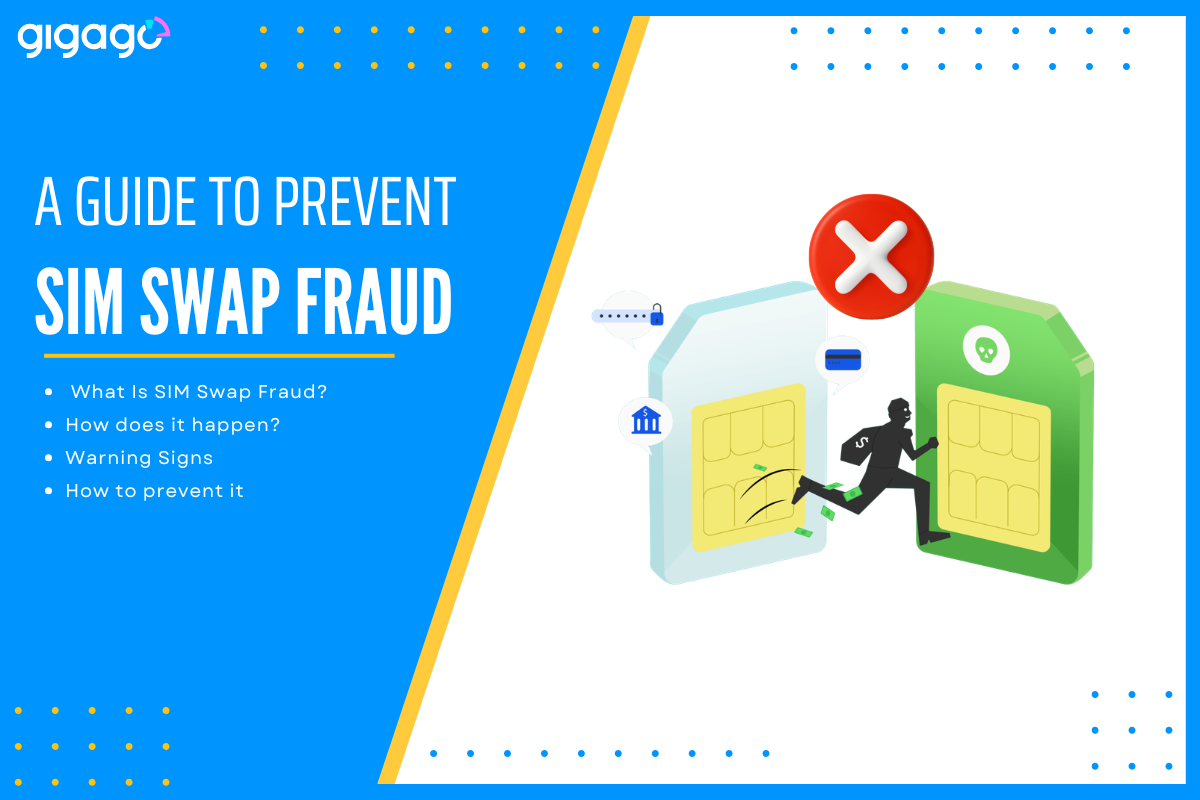
SIM swap fraud (also known as “SIM hijacking”, “Split-porting”) is a digital identity theft where a scammer tricks your mobile carrier into transferring your phone number to a SIM card they control.
They don’t need to steal your phone – they simply take over your number. Once in control, they can receive your calls, texts, and one-time passwords (OTPs), allowing them to access your personal or financial accounts.
Example: You suddenly lose mobile service for no reason. At the same time, a criminal is using your number to access your bank account. That’s SIM swap fraud in action.
II. How Does SIM Swap Fraud Happen?
Here’s how the SIM scam typically works:
Data Collection: Scammers gather your personal info (full name, date of birth, address) through phishing emails, social media, or leaked databases.
The Social Engineering Trap: Using that data, the hacker calls your mobile provider pretending to be you. They might claim they lost their phone or that their SIM card is damaged and request a SIM replacement.
Number Transfer: The carrier issues a new SIM card, unknowingly transferring your number to the fraudster’s device.
Account Takeover: Once in control, the scammer receives your calls and texts – including OTPs – allowing them to reset your passwords and access your accounts.
For travelers, the risk can increase. When you’re abroad, it’s harder to contact your carrier quickly or notice unusual activity.
III. Warning Signs – How to Know You’ve Been Swapped
Suddenly losing mobile service or seeing “No Signal” without explanation.
You stop receiving calls or text messages, but your Wi-Fi still works
Alerts about password changes or login attempts you didn’t make.
Inability to log into your banking app or email accounts.
If you notice any of these warning signs, act immediately – time is critical.
IV. How to Prevent SIM Swap Fraud (Actionable Tips)
You can significantly reduce your risk with a few proactive security steps:
1. Protect Your Personal Information
Go to your phone settings and create a PIN for your SIM card. This prevents the SIM from being used in any other device without the code.
Be cautious about what you share online – avoid posting your full name, birthday, or travel plans publicly.
Never click suspicious links in texts or emails.
Use secure and unique passwords across your accounts.
2. Strengthen Account Security
Use two-factor authentication (2FA) through an authenticator app (like Google Authenticator or Authy), not SMS.
Enable login alerts and security notifications.
Regularly update passwords and use a reputable password manager.
3. Contact Your Carrier for Extra Security
Ask your mobile provider about SIM lock, port-out protection, or PIN lock services.
Use a unique PIN or password for your carrier account.
Immediately report any suspicious activity or unauthorized SIM requests.
4. For International Travelers: Use eSIM for Safer Connectivity
Physical SIM cards can be swapped without your knowledge – but eSIMs remove that risk. With an eSIM, your phone line is embedded digitally into your device, making it far harder for hackers to steal or duplicate.
Services like GIGAGO offer secure, global eSIM solutions for more than 200 countries. You can activate an international eSIM instantly, without waiting for a physical card, and switch between networks securely while abroad.
Here’s how eSIM technology helps prevent SIM swap fraud:
No physical card to replace or steal: The eSIM is built into your device.
Digital activation: Requires device verification and identity confirmation.
Harder to Clone: eSIM profiles are encrypted and downloaded directly to your phone’s hardware, making them much more difficult to replicate through social engineering.
Less human error: No need for carrier store interactions, where impersonation often occurs.
Travel Privacy: By using a Gigago travel eSIM for your data while abroad, you can keep your primary home SIM (linked to your bank) locked or even turned off, keeping it out of reach from local hackers.
That’s why travelers and remote workers increasingly choose eSIMs for both convenience and safety.
VI. What to Do If You Suspect SIM Swap Fraud
If you think your number has been hijacked, take these steps:
Contact your carrier immediately to suspend your number or reverse the SIM swap.
Change passwords for your email, bank, and social media accounts right away.
Enable account alerts and monitor your financial transactions closely.
Report the incident to your bank and relevant authorities.
Acting quickly can help minimize damage and prevent further loss.
VII. Conclusion
SIM swap fraud is a serious threat, but with a few smart habits and the right technology, you can stay safe. Whether you are at home or exploring one of the 200+ countries supported by GIGAGO, keeping your digital identity secure is the best way to ensure your trip stays stress-free.
Short answer: No, if you are visiting multiple countries on a single trip, you do not need to buy a separate SIM card for every border you cross. By installing one regional or global eSIM before you depart, your phone automatically switches to a supported local network as soon as you arrive in a new […]
The 2026 FIFA World Cup runs from June 11 to July 19 — and it’s the most logistically complex tournament in football history. 48 teams. 104 matches. 16 cities. 3 countries. 39 days. If you’re flying in from overseas, this isn’t a weekend trip. It’s a multi-country expedition that punishes poor planning and rewards fans […]
The Da Nang International Fireworks Festival (DIFF) 2026, themed “United Horizons”, will transform the Han River into a world-class stage from May 30 to July 11, 2026. Featuring 10 elite teams, this 6-night festival is more than just a show—it’s a city-wide celebration. It just made Travel + Leisure’s Top 9 Must-Experience Festivals on the […]
Google Maps is widely used globally for navigation and location-based services, but in China it is blocked. For years, the “Great Firewall” has made navigating China a puzzle for Western tourists. While the digital landscape in China is unique, you don’t have to navigate it blind. This article will answer the questions: Does Google Maps […]
With the release of iOS 18, many travelers are wondering: “Does iOS 18 support eSIM?” or “Will the new update affect my travel connectivity?” This guide provides everything you need to know about using eSIM on the latest Apple operating system for a seamless international journey. I. Does iOS 18 Support eSIM? YES. Apple still […]
When you are traveling abroad, nothing is more frustrating than seeing “No Internet Connection” or having signal bars but no internet just as you’re trying to open maps or message someone. If your cellular data stops working, don’t panic — most problems are easy to fix. Whether you’re using a local SIM or an international […]